You do not notice how much of it you do until you try to count.
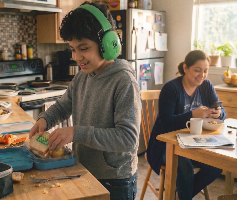
You lay the clothes out. You start the shower and check the water. You cut the food up without being asked, because you know how it goes when you do not.
You make the phone call. It takes two minutes, you have made it a hundred times, and every time you think next time they will make it.
You stand in the doorway and say the next step out loud. Then the next one. Then the one after that.
Nobody has ever offered you help with this part.
Everybody else who works with your kid has a lane. The doctor has the diagnosis. Speech has the words. School, or the day program, has the middle of the day. The lane nobody owns is where your kid actually lives. Getting dressed. Eating. Money. Being alone in the house without something going wrong.
Somewhere in a report you were handed there is a phrase for this. Adaptive functioning. A number sits next to it. Nobody told you what it meant.
So you do it yourself. At night. After work. With no plan, because there is nobody to hand it to.
And the part that makes you feel like you are losing your mind is that they are capable. Every family we work with has one of these. The thing your kid is unreasonably good at, three feet from the thing they cannot start.
Every so often somebody says the sentence.
They'll figure it out when they have to.
They have not figured it out. You have been hearing that sentence for years, and the list has not gotten shorter. It has gotten quieter.
If your kid is eight, the list looks like parenting. If your kid is twenty-eight, it looks like something else. Same list. You just stopped calling it help.
And somewhere in there you started doing math on who does this when you cannot.
Here is what this article hands you.
- What adaptive skills training is, and the skills it covers.
- What an hour of it looks like inside your house.
- Who it is for at every age, and what it costs.
- The email that starts it.
That last one is at the very end. Four lines, thirty seconds, and two numbers that turn your request from something somebody has to research into something they can act on this week.
What is adaptive skills training?
Adaptive skills training is one-to-one teaching of the everyday skills a person needs to run their own life. In California it is a Regional Center service, funded under service code 605, and it happens where the skill happens. Your kitchen. Your bathroom. The bus stop two blocks over.
Nobody writes a lesson plan for these, because most people absorb them by living near adults who do them. A skill nobody teaches on purpose is one nobody notices is late until it is years late.
Here is what falls inside it, the first thing promised.
- Self care. Dressing, bathing, teeth, hair, toileting, getting out the door.
- Home life. Food, laundry, cleaning up, money, phone calls, running a routine with nobody standing over it.
- Safety. Streets, stoves, water, strangers, staying home alone.
- Community. Stores, buses, appointments, ordering, paying, asking an employee for help.
- Talking to people. Starting a conversation, joining a group, saying you need help, hearing a no.
What an hour of adaptive skills training looks like
An hour of adaptive skills training looks like almost nothing, and that is the point. A master's-level specialist, matched to the skill your kid needs, comes to your house when it actually happens and works beside your kid on one piece of it. Nobody runs a class about laundry. They stand at your machine, with your detergent, on the day the laundry is there.
The skill gets cut into steps small enough to win. Then the help thins out on purpose, a little each week, until your kid is doing the step and the adult is only in the room. Then out of it. Expect the first two weeks to look worse, because somebody helped through a step for years will push back the first time the help thins.
That last part is the entire job.
Being smart and being able to run your own day are two different skills. Everybody keeps score of the first one.
That gap is why the most capable-looking people get offered the least help. Every year we start programs with people who can explain the whole task and cannot begin it. Some are eight. Some are thirty-eight.
Earlier is easier, and that is not the whole truth. The longer a house has been organized around helping, the more of the work is undoing the habit. Slower, not different, and not too late.
Who adaptive skills training is for
Adaptive skills training does not stop at eighteen. It is funded at every age, from Early Start in infancy through adult services. As of September 2026 there is no window you already missed.
Adults are where we see the widest gap between what is funded and what gets asked for. The paperwork does not change at eighteen. Fewer people bring it up, and the list at home grows anyway.
It fits when the gap is a skill. If your kid knows what to do and cannot start, or was never taught it, that is this. It carries its own authorization, so asking risks nothing you already have.
What adaptive skills training costs
Nothing. There is no bill for this.
Your Regional Center funds adaptive skills training. No copay, no deductible, no sliding scale, no invoice. Families in our programs pay zero out of pocket.
Which means you are not shopping. If your kid is already a Regional Center client, this is on the list your Regional Center funds, and it has been there the whole time. Authorization turns on what your kid needs.
The money question, the one that quietly kept you from asking, is already answered.
Questions parents actually ask
Is this the same thing as ABA?
No. Behavior services go after behavior that is getting in the way. Adaptive skills training goes after the skill itself, where it gets used. Plenty of families have both.
Is my kid too old for this?
No, and it is the question we hear most from families of adults. Adult programs have the most ground to cover: cooking, buses, money, living with somebody who is not you.
Is this just babysitting?
Fair, and worth checking. Ask to see the written plan, the named skills, and last month's notes on what changed. If nobody can show you those, what you have is respite. Useful, but different.
My kid is not a Regional Center client yet.
Then eligibility comes first. It runs on a qualifying developmental disability and an evaluation, separate from any service. Our eligibility page covers where to start.
The list will still be there tomorrow. That part does not change on a Tuesday.
What changes is how long it stays yours, and that comes down to whether anybody asks. If you have a service coordinator, the person who manages your Regional Center plan, this is one email.
Two numbers make it work. The vendor number says which agency, the service code says which service, and nobody has to look either up before saying yes.
Hi [service coordinator's name],
I would like to request Adaptive Skills Training for [name], UCI [number], through Levi Life Skills, Vendor #PL2640, Service Code 605.
Thank you,
[your name]
The UCI number is the client ID on your Regional Center paperwork, near the top of the first page. For a different agency, swap the name and number.
Send it and it is out of your hands, which is a better place for it than 11pm and your own head. If you want the first month from our end, how it works covers it.
You have been the whole program for years. No training, no plan, no relief, and a list you never agreed to keep. Nobody ever told you that you were allowed to hand part of it back.