Your kid has school. Then your kid has you.
That is the whole social calendar, and it has been for a while.
Nobody calls. There are no birthday invitations on the fridge, and you know the month they stopped coming.
Saturday, you are the friend. Sunday, you are the friend. Winter break, you are the friend for seventeen days straight.
It is not that you have not tried. You have a list of things that did not work. A season that ended on the sideline. A class you paid for and quit driving to in week three. A party where you stood in a stranger's backyard while your kid lined up their folding chairs.
Somewhere in there you made a quiet decision you have not told anybody, which is that you are done signing them up for things.
That is the real cost. Not the class. The decision.
Everybody has the same advice for you:
Just get them around other kids.
Pediatricians say it. Teachers write it at the bottom of the report. It is the most repeated sentence in this whole field and it is missing one word.
Around is not with.
Nobody who says it tells you where to go, and the places most people name first are the likeliest to fail them.
Here is what this article hands you.
- Ten real places, sorted by age, from a two-year-old up through high school, with what each costs.
- The one question to ask before you sign up for anything, which takes about nine seconds.
- The place your Regional Center already pays for, which almost no family asks about.
And one number you can collect from a folding chair, which tells you whether a place will work before you buy the season. That is at the end.
Start with the question, because you can use it tomorrow. Before you sign up for anything, ask whoever runs it: what are the kids doing with their hands?
If the answer is a thing, you are probably fine. Throwing a ball at a target. Turning pages. Rolling dice. Passing a drum.
If the answer is each other, walk away. Free play. Social hour. Mixer. Those are the hardest rooms in the building, and they are the ones we send our kids to first.
Why does my autistic child not talk to the other kids?
Because most rooms ask them to start, and starting is the piece that is missing. A crowd of kids is the hardest version, in front of an audience.
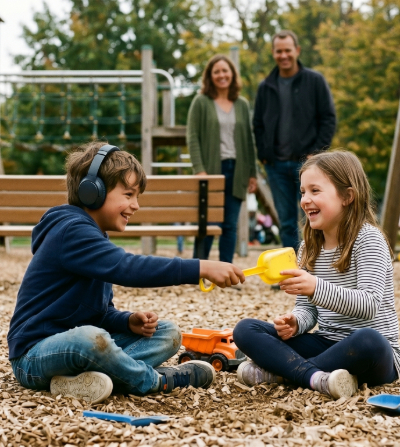
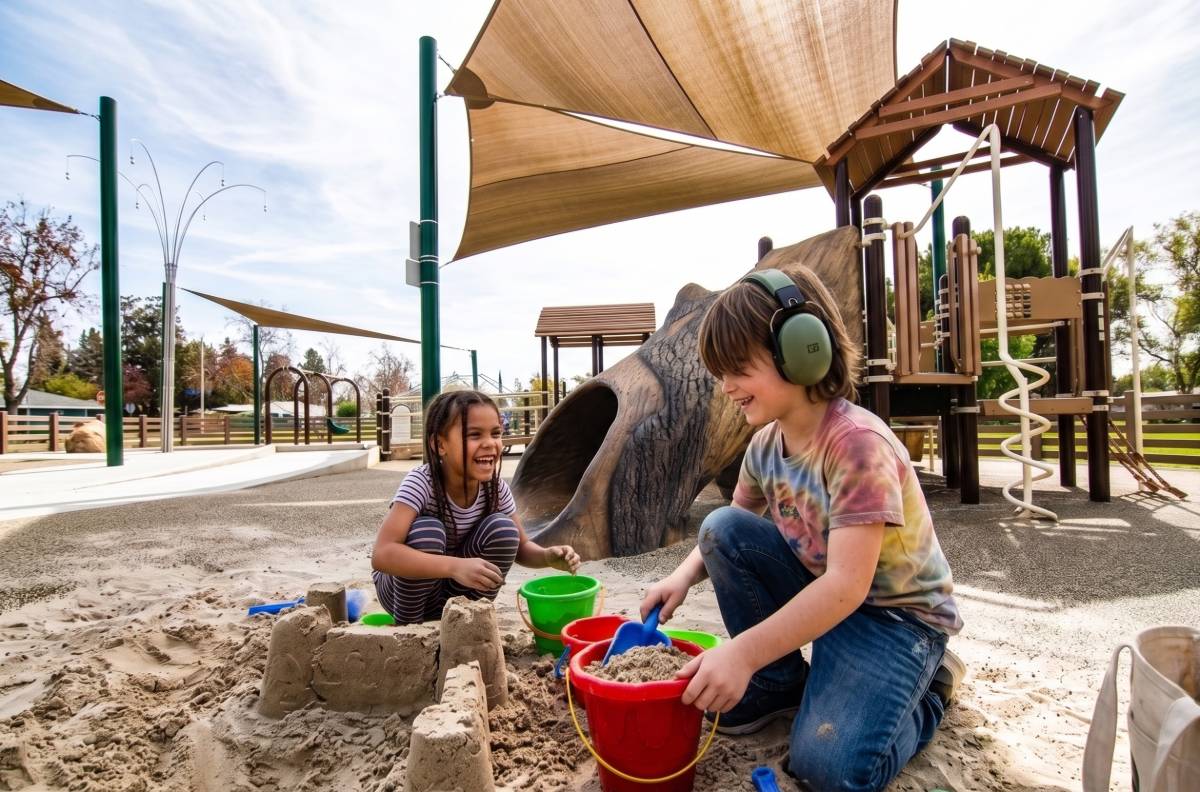
Watch two kids who are connecting sometime. They are almost never facing each other. They are shoulder to shoulder, looking at a third thing.
The third thing is the ball. Or the book, the dice, the drum. It hands them something to say and it tells them where to stand. It also makes silence normal, so the kid who needs eight seconds to answer does not lose their turn.
Take it away and you get a kid behind the goal, or eating lunch in the library.
Every place below has a third thing in it. That is why it is here.
Which place fits my child's age?
Ten places, youngest to oldest. Five of them are free.
| Place | Ages | What it costs |
|---|---|---|
| Sensory storytime and sensory kits at the library | 2 to 12 | Free |
| Special Olympics Young Athletes | 2 to 7 | Free |
| Sensory-friendly hours at a museum or theater | Any age | Regular admission |
| PlayLA and your city's adaptive rec program | 5 to 17 | $10 a season |
| Challenger baseball and AYSO EPIC soccer | 4 and up | Varies, often free |
| Social recreation funded by your Regional Center | Any age | Free, no copay allowed |
| Special Olympics sports | 8 and up, no limit | Free |
| Best Buddies | High school through adult | Free |
| A tabletop gaming group | 10 and up | Free to modest |
| A club or Unified Sports team at school | Middle and high school | Free |
Where do I take an autistic child under 8?
Somewhere short, free, and identical every week. A four-year-old does not need variety. They need the same rug and the same closing song, until the room is boring enough to look up from.
1. Sensory storytime and the sensory shelf at your library
Thirty minutes, free, no sign-up, and you can leave whenever. That combination exists nowhere else, which is why we start more families here than anywhere. The third thing is the book, and after the book it is the shaker eggs.
Eight Los Angeles Public Library branches now have sensory-friendly spaces with quiet nooks, fidgets, and headphones to borrow. Canoga Park and Sunland-Tujunga are the two in the Valley. Ask your branch about small group storytime, built for kids who cannot handle a room of forty.
2. Special Olympics Young Athletes, ages 2 to 7
Young Athletes is running, kicking, and throwing at stations, and it is free. It is the earliest real answer to "where do they go," starting at two. What sells it is the second half of the curriculum: alongside the motor skills it teaches sharing, turn-taking, and following a direction from an adult who is not you. Those three are the entry fee for every other room your child will walk into.
3. Sensory-friendly hours at a museum or a movie theater
Discovery Cube LA in Sylmar opens for Sensory Friendly Mornings the third Sunday of every month, 8am to 10am, two hours before the public gets in. Music off, cue cards out, one aide per family free. AMC runs Sensory Friendly Films with the Autism Society on the second and fourth Saturday at 10am, lights up and sound down.
Be honest about this one. The third thing is weak and your child may not speak to anybody. It is partly for you. Two hours in public where no stranger turns around is worth more than the exhibits.
Where do I take a school-age autistic child?
School-age kids do better in a league with rules, and this is where parents pick wrong. The instinct is to hunt for the warmest, loosest, most welcoming program on the list.
The rigid one usually works better.
A whistle, a start time, a line to stand in, and the same drill every week give your child a script for their body. Warm and loose gives them an open room and a smile, which is the class you quit driving to. For a lot of these kids, structure is the kindest thing in the building.
4. PlayLA, and your city's adaptive rec office
PlayLA is the City of Los Angeles youth sports program, ages 5 to 17, $10 per registration with scholarships available. The adaptive side runs wheelchair basketball, adaptive swim, sitting volleyball, goalball, and adaptive skateboarding at rec centers across the city.
Outside city limits, ask your parks department the same question. Santa Clarita takes requests through Inclusion Support, where staff look at what your child needs to join a regular city class. They do not assign a one-to-one aide, so ask early.
5. Challenger baseball and AYSO EPIC soccer
Every player gets a buddy. That is the whole design of both leagues, and it is the difference between them and every league that did not work.
The Little League Challenger Division started in 1989 and takes players 4 to 18, or to 22 if they are still in school. Senior League Challenger takes 15 and up with no maximum age. Granada Hills and Canyon Country both run teams; the league finder gets the nearest one. AYSO EPIC, formerly VIP, is the soccer version: ages 4 to 99, no tryouts, no cuts.
6. The social recreation your Regional Center already pays for
Families never ask for this one because it was gone for twelve years. California cut social recreation and camp funding in 2009 and brought it back in 2021. Word never reached most of the families it came back for.
It can fund day camp, overnight camp, swim lessons, horseback riding, art, dance, and music. It is not allowed to charge you a copay, and it cannot make you trade away respite hours to get it.
Ask your service coordinator to write it into the plan, and name what you want. "Six weeks of day camp this summer" gets a yes more often than "something social." Our piece on what to ask for at an IPP meeting has the wording.
California Department of Developmental Services The official page on Regional Centers, eligibility, and what they fund →Where do autistic teenagers gather?
In four places, and two of them are inside the building they already walk into every day. School hands you a building full of same-age people five days a week. At 18 or 22 the building goes away and nothing replaces it. These four do.
7. Special Olympics sports, which do not stop at 18
Special Olympics Southern California runs 13 sports for nearly 25,000 athletes across 11 counties. Sports start at age 8, there is no upper age limit, and it is free to athletes and families.
The no-upper-limit part is what matters for a parent of a 16-year-old. It is one of the only things here a person can join at 8 and still do at 60.
8. Best Buddies, at the high school and after it
Best Buddies pairs a person with a developmental disability one to one with a person without, matched on where they live and what they are into. California has 200 chapters in 114 cities, 107 of them in high schools.
Best Buddies matches a pair for at least a year, and they meet in person twice a month. That is not a club meeting. That is a person who texts your kid.
If the high school has no chapter, students can start one. Ask the front office who would sponsor it.
9. A table with dice on it
Tabletop games are the strongest third thing on this list for a teenager, because the rules do the social work. Whose turn it is, how long you talk, when it ends: all of it is written down. Nobody has to read a face.
A 2024 study in the journal Autism ran a six-week campaign with a small group of autistic adults, then asked them about it. What came back was connection without masking.
Ask the game shop nearest you when open D&D night runs, and check whether your library runs teen gaming. For a trained adult at the head of the table, Game to Grow keeps a directory of certified game masters, many of them online.
10. The club that already meets in the school building
Free, already on the calendar, and three minutes from last period. Robotics, marching band, theater crew, yearbook, and esports all have a shared task at the middle of them.
Ask the office which clubs meet and when, then ask whoever runs it whether your kid can come once and try.
Ask whether the school is a Unified Champion School too. Special Olympics runs more than 130 in Southern California, and Unified Sports puts students with and without intellectual disabilities on the same team. If the school is not one, it can apply.
Somewhere in the teen years your job stops being the one who signs them up and becomes the one who drives them. They pick. You drive.
How do I run the first visit?
Go once with nothing riding on it.
- Go ten minutes early, so the room fills up around them instead of the reverse.
- Show them a photo of the building before you leave.
- Say when you are leaving before you go in, then stick to it.
- Sit down and stay sat. Hovering turns other kids away faster than anything your child does.
- Plan on three visits before deciding. The first tells you almost nothing.
If they freeze at the edge, that is normal, and our piece on coaching a child into the group covers the prompting step by step.
Questions parents actually ask
Is a special-needs-only program keeping my child separate?
Fair. Separate is where most kids build the skill and mixed is where they use it, so run both when you can. A kid who has never once succeeded socially does not need a harder room. They need one win.
They say they do not want to go. Do I make them?
Go three times, then let them decide. "I don't want to" usually means "I don't know what happens there," and that changes once they do.
My teenager has zero interest in sports. What then?
Skip it and go find the dice. Gaming, robotics, anime club, choir, and theater crew all have a third thing in them and none of them involve a whistle.
Is any of this going to turn into an actual friend?
Sometimes, and slower than you want. First comes a kid who is comfortable near other kids, and that has to exist before a friendship has anywhere to grow. Best Buddies is the one built to produce a named person.
What happens when they age out of school?
The rooms change and the rule does not. Our piece on where autistic adults meet people covers the ten that work after 18, including what Regional Center still pays for.
My child is not a Regional Center client. Does that shut most of this down?
Only number six. Everything else takes any child who walks in. If you think your child may qualify, the eligibility check is where that starts.
Here is the number.
Go once, sit down, and do not help. Count the minutes your child spends inside arm's reach of another person, both aimed at the same thing. Not near. Arm's reach, same object.
Under five minutes in an hour and the room has no third thing in it. Five is the number we use.
The number grades the room, not your child. A bad one just means you get to leave in week one instead of week eight.
Every room on that list of things that did not work would have scored a zero. You could not have known that in week one. Now you can, by 10:15 on the first morning, and it costs a folding chair and an hour.
Somewhere on that list is a room where your kid puts a hand on the same ball as another kid. On day one it looks like two kids doing one boring thing next to each other. That is how it starts for everybody else too.
If you want somebody working on the skill alongside you while you find that room, here is how getting started works. It is funded through your Regional Center and costs your family nothing.
Sign them up for one more thing. Just ask what the kids are doing with their hands first.